» Catalog »
Store Logo
Your Account
Sign In
 
Lost password?
Categories
Books
PaperbackHardcoverBoard books - softcoverBoard books - hardcoverBookletWire-O - softcoverWire-O - hardcoverBook edge printing
Shopping Cart
0 items
Articles
How to Prepare Files for Print
Knowledge Base
Template Generators
Contact
Information
Fast delivery to your door
Refinements

Refinements are the details that give a cover its unique character and enhance its visual appeal. Here we present popular print refinements such as lamination, Spot UV Varnish on the Cover (flat and 3D), Flat Metallic Foil on the Cover, 3D Metallic Foil on the Cover and Book Edge Printing.


Lamination


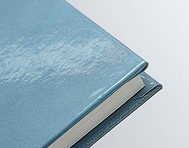
Lamination


A basic cover protection that safeguards the print and gives it character. Choose matt, gloss or soft-touch lamination to achieve the desired visual effect and improve durability.


Spot UV Varnish on the Cover


Spot UV Varnish on the Cover


Precise application of glossy varnish to selected graphic elements. This refinement subtly highlights details such as the title or logo.


3D Spot UV Varnish on the Cover


3D Spot UV Varnish on the Cover


: A striking refinement creating a tactile raised structure that enhances selected cover elements. Ideal for emphasising the most important cover elements and adding a three-dimensional effect.


Flat Metallic Foil on the Cover


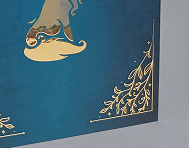
Flat Metallic Foil on the Cover


: A modern digital method of applying metallic foil (e.g. gold or silver) to the cover. This technology enables precise metallic detailing without the use of dies, giving the publication a premium appearance.


3D Metallic Foil on the Cover


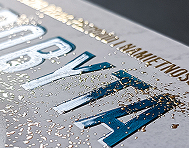
3D Metallic Foil on the Cover


: A combination of metallic shine and a digitally created raised 3D structure. This eye-catching finishing option gives the cover exceptional depth.


Die-Cut Window in the Cover


Die-Cut Window in the Cover


A creative solution involving a cut-out window of any shape in the cover. The window exposes the first page, interior content or specially designed endpapers.


Rounded Book Corners


Rounded Book Corners


A subtle detail that softens the shape of the book and gives it a modern, softer appearance. Frequently used for notebooks, calendars and children’s books.


Rounded Book Block Corners


Rounded Book Block Corners


A finishing option involving rounding the corners of all pages in the book block. Most often used together with Rounded Book Corners for a cohesive and elegant result.


More About Printing Technologies

Discover the possibilities of digital printing at Books Factory. We explain the differences between economical high-speed inkjet printing (mono and colour) and standard electrophotographic printing. Learn which technology is optimal for your print run, paper type (uncoated, coated, Munken, Eco-Book) and publication type (black-and-white, colour or illustrated).

Which printing technologies do we use?

At Books Factory, we use two main digital printing approaches:

  • standard printing (electrophotographic, toner) — high quality and precise reproduction,
  • economical printing (high-speed inkjet) — cost optimisation while maintaining good quality.

Both technologies differ in visual effect, application and cost efficiency depending on the project.

Standard printing (electrophotographic, toner)

This solution is focused on quality — especially where graphic design plays a key role.

  • available in colour (4+4), mono (1+1) and mixed (4+1) variants,
  • very good optical density and detail sharpness,
  • excellent reproduction of contrasts, blacks and solid ink areas.

It works best for.

  • albums, reproductions and illustrated books,
  • comics and projects with high graphic coverage,
  • publications requiring high print precision.

It can be used on all papers available at Books Factory — both coated and uncoated.

Economical printing (high-speed inkjet)

This solution is designed for cost efficiency and production speed. It is available in two variants.

Economical mono

  • intended mainly for text-based publications,
  • works best for simple illustrations without strong contrasts or large solid ink areas,
  • most cost-effective for higher print runs.

Used exclusively on uncoated papers (e.g. uncoated, Munken, Eco-Book).

Economical colour

  • dedicated to colour publications and mixed mono/colour interiors,
  • more versatile than the mono variant,
  • cost-effective even for lower print runs.

It works well for most projects, except highly demanding albums with large solid ink areas. It can be used on most coated and uncoated papers.

How to choose the right printing technology?

Technology selection depends on several key factors:

  • publication type — text-based, illustrated or album-style,
  • print run — from single copies to large series,
  • graphic detail level — including solid ink areas, contrasts and fine details.

In practice:

  • graphic and premium projects → standard printing,
  • text-based and economical publications → inkjet printing.

Paper and printing technology

Paper type directly influences the final effect and should be selected together with the printing technology.

  • coated papers — better for graphic-heavy projects and standard printing,
  • uncoated papers (uncoated, Munken, Eco-Book) — ideal for text-based publications and inkjet printing.

This combination determines readability, contrast and the overall visual perception of the book.

What next?

If you already know your publication type and paper choice, you can proceed to the calculator and check how the selected technology influences production cost and parameters. For more complex projects, it is worth comparing several variants — especially for colour and illustrated books.